
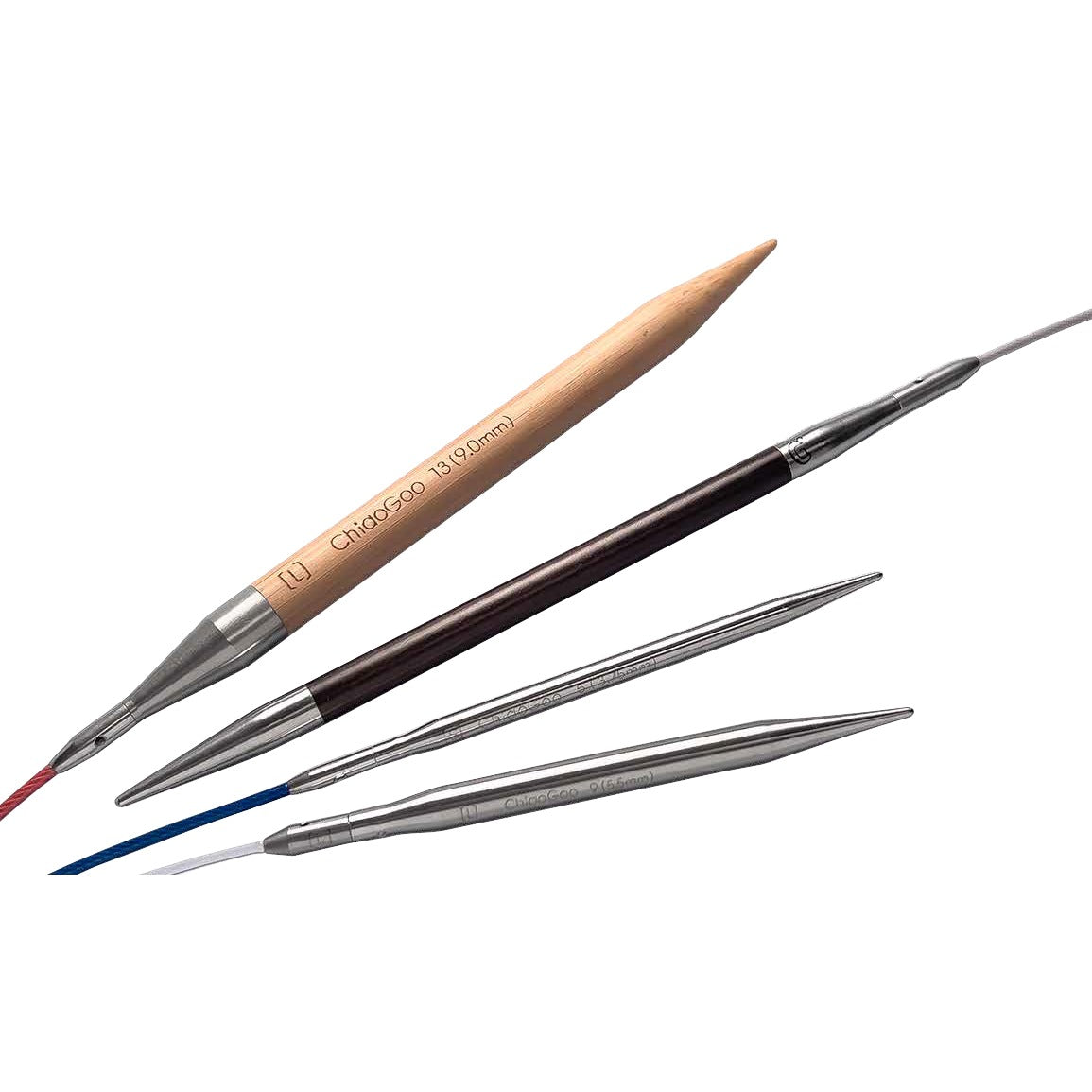
Interchangeable tips commonly come in four lengths (2, 3, 4, and 5 inches), and choosing the right length can be confusing. Ask two knitters and you'll get two different answers. Ask three more, and you might be trying to make sense of five different answers.
Because the tips are what you hold, personal preference is an important factor. There's another critical factor: tips are part of a circular needle's overall length, and their length determines the shortest circular needle you can build with those tips.
I'm using ChiaoGoo cables and join sizes as examples in this article because that's what we stock. The same principles apply across brands, although the available tip and cable lengths, and which parts fit together, vary. (If you're choosing a ChiaoGoo set, don't miss our set guide.)
An Interchangeable Is Still a Circular Needle
The difference is that instead of buying the tips and cable permanently joined, you choose three things:
- Needle size (US-6, US-8, and so on): what your pattern and gauge call for, same as always.
- Tip length (2, 3, 4, or 5 inches, in ChiaoGoo's range): how much needle your hand holds, and how short a circular you can build.
- Cable length: combines with the two tips to set the finished needle's length.
A 16-inch interchangeable circular is measured the same way as your 16-inch fixed circular: from one needle point all the way around to the other. With ChiaoGoo, two 4-inch tips on an 8-inch cable make that familiar 16-inch circular. The tips screw onto the cable at a small metal collar called the join.
The Short Version
| If the shortest circular you want to knit on directly is... | Start with |
|---|---|
| 24 inches or longer | 5-inch tips, or 4-inch if they feel better in your hands |
| 16 inches | 4-inch tips |
| 12 to 14 inches | 3-inch tips |
| 9 or 10 inches | 2-inch tips |
| You use Magic Loop, two circulars, or DPNs for small circumferences | You may not need short tips at all |
Your project determines how short the tips need to be. Your hands determine which of the remaining choices feels best.
Start With the Needles You Use Now
If you use fixed circulars, think about which lengths you reach for. If 16-inch circulars are your workhorse for hats, cowls, and necklines, 4-inch tips are the length that reproduces them. If you mostly knit on 24-inch and longer circulars, both lengths work and comfort decides; many knitters like the extra inch of a 5-inch tip. If you love a 9-inch circular for socks, the interchangeable version of it takes 2-inch tips.
If you use DPNs, decide whether you want interchangeables to replace them. If your DPNs are staying, comfortable 4- or 5-inch tips cover the larger work while your DPNs keep the sleeves, crowns, and socks. If you'd rather move some of that DPN knitting onto one small circular, that's the job of the 3-inch and 2-inch tips.
If you use straight needles, flat knitting puts no limit on tip length, so comfort alone decides. A 5-inch tip gives your hand the most to hold, though no circular tip feels like a full-length straight.
What Overall Circular-Needle Length Do You Need?
Interchangeable cables are labeled with the cable length alone, not the finished needle, no matter the brand. To find the needle length, add both tips:
tip + cable + tip = tip-to-tip length
Two 4-inch tips on an 8-inch cable make a 16-inch (40 cm) circular. The printed tip length already includes the join.
| Cable | 2-inch tips | 3-inch tips | 4-inch tips | 5-inch tips |
|---|---|---|---|---|
| 5-inch | 9 | won't work | ||
| 6-inch | 10 | 12 | ||
| 8-inch | 12 | 14 | 16 | won't work |
| 14-inch | 18 | 20 | 22 | 24 |
| 22-inch | 26 | 28 | 30 | 32 |
(Finished tip-to-tip lengths, in inches, and all measurements are approximate. Empty cells are pairings that don't make a workable circular either. Cable lengths are ChiaoGoo's; the arithmetic works for any brand.)
When a pattern calls for a "16-inch circular," it means a circular needle about 16 inches from point to point: find a combination that totals 16. When a pattern says "9-inch circular or DPNs," it means a circular needle about 9 inches long, and the DPNs, Magic Loop, or two circulars are alternative ways to knit the same small circumference.
Two cells say won't work even though the arithmetic checks out. Here's why.
Only the cable bends
When you knit in the round, your stitches travel a closed loop, but only the cable can curve. The tips stay straight. On a 40-inch blanket, two 5-inch tips are a rounding error. On a 16-inch hat, they're more than half the circle, and the loop stops behaving like a ring.
So your needle needs to be a bit shorter than the circumference you're knitting, tips included. That's true for every brand: nobody's 5-inch tip makes a 16-inch needle. (A few systems go longer than 5 inches. Every extra inch of tip raises the shortest circular it can build.)
You may see tidy formulas like "keep the tips under a third of the total." They don't hold up: two 4-inch tips on an 8-inch cable is half rigid and works beautifully. The smaller the circumference you're knitting, the less of your loop can be stiff.
Quick tip: if you're stretching the work taut to bring the tips together, the cable is too short for your grip. Go up a length.
When knitting flat, any tip length works on a circular long enough to hold the stitches. Whether knitting in the round or flat, the feel of the tips in your hands also matters, so let's take a look at that next.
Where Does the Needle Rest in Your Hand?
Hand size is not the deciding factor, even though "small hands take 4-inch, large hands take 5-inch" is common advice. What matters is where the needles rest in your hands while you knit.
- Against your palm or the web of your thumb: more shaft usually feels better, and 5-inch gives the most.
- Braced by your ring and pinky fingers: 5-inch gives them the most to hold.
- Controlled mostly by your fingertips: a shorter tip can feel perfectly natural. Either length works; 4-inch feels nimbler, and 2-inch tips are viable.
- Coming from long straights tucked under your arm (lever or Irish cottage style): no circular tip is long enough to tuck. Lever knitters who adapt steady the tip in the hand instead, and the longest tip available gives the most to steady (5-inch, in ChiaoGoo's range); 2-inch tips are unlikely to work for this style.
How you manage yarn matters too, though less than where the needle rests. If your hand leaves the needle to wrap each stitch (yarn in your dominant hand, throwing), the needle needs enough shaft to stay put on its own. If your hand never lets go (yarn in your non-dominant hand, picking), you can get by with less. Grip still varies more than style: Continental knitters can hold needles deep in the palm, and English knitters can work from the fingertips.
Both hands count, but the hand that forms the stitches needs more shaft than the hand feeding them.
If a tip length makes you clench or pinch to keep the needle steady, it's too short for your grip.
4-Inch or 5-Inch?
ChiaoGoo's standard 16-inch circular is two 4-inch tips on an 8-inch cable, and 5-inch tips are too long to make a comfortable 16-inch circular. Two 5-inch tips need at least the 14-inch cable, which makes a 24-inch (61 cm) circular. If 16-inch circulars are part of your knitting, 4-inch is your length.
If your circulars start at 24 inches, both lengths work and comfort decides: 5-inch gives your hand more to hold, and 4-inch feels nimbler in fingertip grips.
The join placement differs too. With 4-inch tips the join can fall inside the palm; with 5-inch tips it usually sits farther back. If you can feel the join while you knit, or you find yourself bending the cable sharply at your hand, try the other length. (Why cables fail, and what the warranty covers.)
You give up no sizes either way. Both 4-inch and 5-inch tips run US-000 (1.5 mm) through US-15 (10 mm).
Do You Need Short Tips at All?
If Magic Loop or two circulars suit you, you may never need a tip shorter than your comfort length. Short tips are for knitters who'd rather knit small circumferences directly in the round: no loops to pull, nothing to reposition, and no needle transitions to ladder.
Pick your method first, then buy tips to match.
- Magic Loop: one long, flexible cable (32 inches or more) pulled out in two loops. Handles any circumference on your choice of tips.
- Two circulars: the stitches split across two needles, so tip length never limits circumference.
- Flexible double points: short needles with a bendy middle, worked like DPNs. You can make your own from ChiaoGoo parts: a 2-inch cable between two 3-inch tips makes an 8-inch flexible double point, and ChiaoGoo sells the 2-inch cables in a 3-pack.
- Classic double points still work fine; they're often the tool short-tip shoppers are replacing.
3-Inch Tips: The Easier Way Into Short Circulars
Two 3-inch tips make a 12-inch (30 cm) circular on a 6-inch cable or a 14-inch on an 8-inch cable: the range for adult sleeves, baby garments, and hats too small for 16 inches.
They give your hand meaningfully more to hold than 2-inch tips, making them an easier adjustment before knitting with 2-inch tips. Sleeves are the runaway favorite use in our reviews. Kathleen H., on the Blue Shorties set: "I struggled with the magic loop and finally decided to splurge on the blue set of shorties. Knitting sleeves with these needles is a game changer for me…no more gaps!"
ChiaoGoo sells 3-inch tips as single pairs, US-000 through US-11, so one pair plus a 6-inch cable is a good way to test whether short-circular knitting suits you.
2-Inch Tips: The 9-Inch Specialist
Two-inch tips are the only length that makes a 9-inch (23 cm) circular, on the 5-inch cable: the tool for narrow sock legs. A fixed 9-inch circular is the same geometry with the decision made for you.
These tips are held almost entirely in the fingertips. Some knitters find that freeing; others grip harder and tire. Shorter doesn't always mean easier on the hands; it often means the opposite.
ChiaoGoo doesn't sell 2-inch tips on their own. They come in the Red and Blue Shorties sets and the size-specific Combo Packs (one pair each of 2-inch and 3-inch tips, plus two short cables). The cables in a Shorties set build 9 through 14 inches, and longer cables in the matching join size are sold separately.
Which Length for Which Project?
| Project | Start here | What may change |
|---|---|---|
| Adult hat | 4-inch tips + 8-inch cable (16 inches) | Crown decreases need Magic Loop, DPNs, or a shorter setup |
| Baby or child hat | 3-inch tips (12 or 14 inches) | Crown still needs another method |
| Cowl | 4-inch for a 16-inch cowl; either for larger | Let the pattern circumference decide |
| Sweater body or yoke | 5-inch if that grip suits you; 4-inch is fully capable | The cable carries the stitches, not the tips |
| Sleeve | 3-inch tips (12 to 14 inches) | Longer cable and Magic Loop as it narrows |
| Sock leg and foot | 2-inch, or mixed 2 and 3 | Heel flap worked flat; toe needs a switch |
| Mitten or glove | 2-inch tips (9-inch circular), Magic Loop, or DPNs | Thumb and top shaping are too small for the short circular |
| Shawl, blanket, flat knitting | Usually 5-inch, for grip and leverage | No circumference limit; comfort decides |
Mix Your Tip Lengths
A Red or Blue Shorties set has 2-inch and 3-inch tips in every size, and you don't have to use a matched pair. Put the 3-inch tip in the hand that forms the stitches and the 2-inch in the hand feeding them. That gives the extra shaft to the hand that needs it without adding two inches to the circular.
Some knitters switch between combinations as they go. Jeri B.: "I like that I can use the 2″ needles for a 9″ total but when my hand starts to cramp I switch one for 3″ which helps."
| Tips + cable | Tip-to-tip |
|---|---|
| 2 + 5-inch + 2 | 9 inches |
| 2 + 6-inch + 2 | 10 inches |
| 2 + 6-inch + 3 | 11 inches |
| 3 + 6-inch + 3 | 12 inches |
| 2 + 8-inch + 3 | 13 inches |
| 3 + 8-inch + 3 | 14 inches |
That's every length from 9 through 14 inches out of one Red or Blue set. Just remember the 5-inch cable is for two 2-inch tips only; ChiaoGoo cautions that longer tips on its shortest cables put too much strain on the join.
Where Short Circulars Stop Working
The work changes shape and the needle doesn't. Sock toes, mitten tops, and hat crowns eventually shrink past even a 9-inch circular, and a heel flap is worked flat. When the work gets too small, switch to Magic Loop, two circulars, or double points.
Expect an adjustment period, too: short tips feel fumbly for the first few inches, then most hands settle in. Whether you'll adapt at all, and the low-risk way to find out, is covered in the set guide.
Before You Order: Check the Join Size
Tips only fit cables with a matching connection, and brands handle this differently: some use one connection size for their whole range, while ChiaoGoo uses three join sizes, Mini [M], Small [S], and Large [L]. Join size is a compatibility question, not another comfort decision: choose your needle size and tip length first, then make sure the cable has the matching join.
In ChiaoGoo's system the join boundaries shift between tip lengths, and that detail results in occasional mis-orders.
| Tip length | Mini [M] | Small [S] | Large [L] |
|---|---|---|---|
| 2-inch (Shorties only) | US-000 to US-3 | US-4 to US-8 | not offered |
| 3-inch | US-000 to US-3 | US-4 to US-8 | US-9 to US-11 |
| 4-inch and 5-inch | US-000 to US-1.5 | US-2 to US-8 | US-9 to US-15 |
Look at US-2 through US-3. On 2-inch and 3-inch tips those sizes take Mini [M] joins; on 4-inch and 5-inch tips the same sizes take Small [S]. If you own a 4-inch Small Set, it includes Small [S] cables that fit its 4-inch US-2 and US-3 tips. But get a Red Shorties set, and its US-2 and US-3 tips won't fit the cables in your 4-inch Small Set.
ChiaoGoo's adapters connect tips to the next smaller size of cable: one joins Small [S] tips to Mini [M] cables, and the other joins Large [L] tips to Small [S] cables.
Quick Questions
Can you connect two cables? Yes. Cable connectors join two or three cables end to end: the Yellow Shorties' two 6-inch cables become a 12-inch cable. A joined cable also lifts the 8-inch cable's tip limit; any tip length works on the longer combination.
Will changing tip length change your gauge? It can. A different tip length can change how you hold the needles and tension the yarn, so your gauge may shift even though the needle diameter is the same. For a gauge-sensitive project, check your gauge again after changing tip lengths or methods.
Does the material (bamboo or stainless steel) change the answer? No. Material changes the feel, not the geometry. Shorties come in stainless steel only; choose length first, then material.
Try One Pair Before You Buy a Set
Buy one pair in a size you knit regularly (for 2-inch tips, a Combo Pack) and knit 15 minutes of knits, purls, decreases, and ribbing. It might feel awkward at first, but that should improve. That's why the full 15 minutes matters: discomfort rarely shows in the first few rows. Adjust if needed. If 4-inch feels unsupported, try a pair of 5-inch tips. If 5-inch feels cumbersome, try a pair of 4-inch tips. If 2-inch cramps, try the 3-inch pair or the mixed setup.
The Bottom Line
Use 16-inch fixed circulars now? Start with 4-inch tips.
Mostly knit flat, or on 24-inch and longer circulars? Start with 5-inch tips if they feel comfortable in your hands.
Want to move sleeves and other small circumferences off your DPNs? Look first at 3-inch tips, sold as single pairs. Want a 9-inch circular for socks or the smallest work? That's what 2-inch tips are for.
Happy with Magic Loop, two circulars, or DPNs for small circumferences? You may never need short tips at all.
A good rule of thumb: choose the longest tip that's comfortable in your hands and still makes the shortest circular needle you want to knit on directly.
Smartisans has been an authorized ChiaoGoo dealer for more than a decade, so you get ChiaoGoo's warranty behind every purchase, and we restock weekly with shipments direct from Westing Bridge LLC in Troy, Michigan.
Sources and further reading
- Our companion posts:
- ChiaoGoo's pages:
- Patty Lyons, "Let the Tool Do the Work"
- Laylock Knitwear Design, "All About Circular Knitting"