
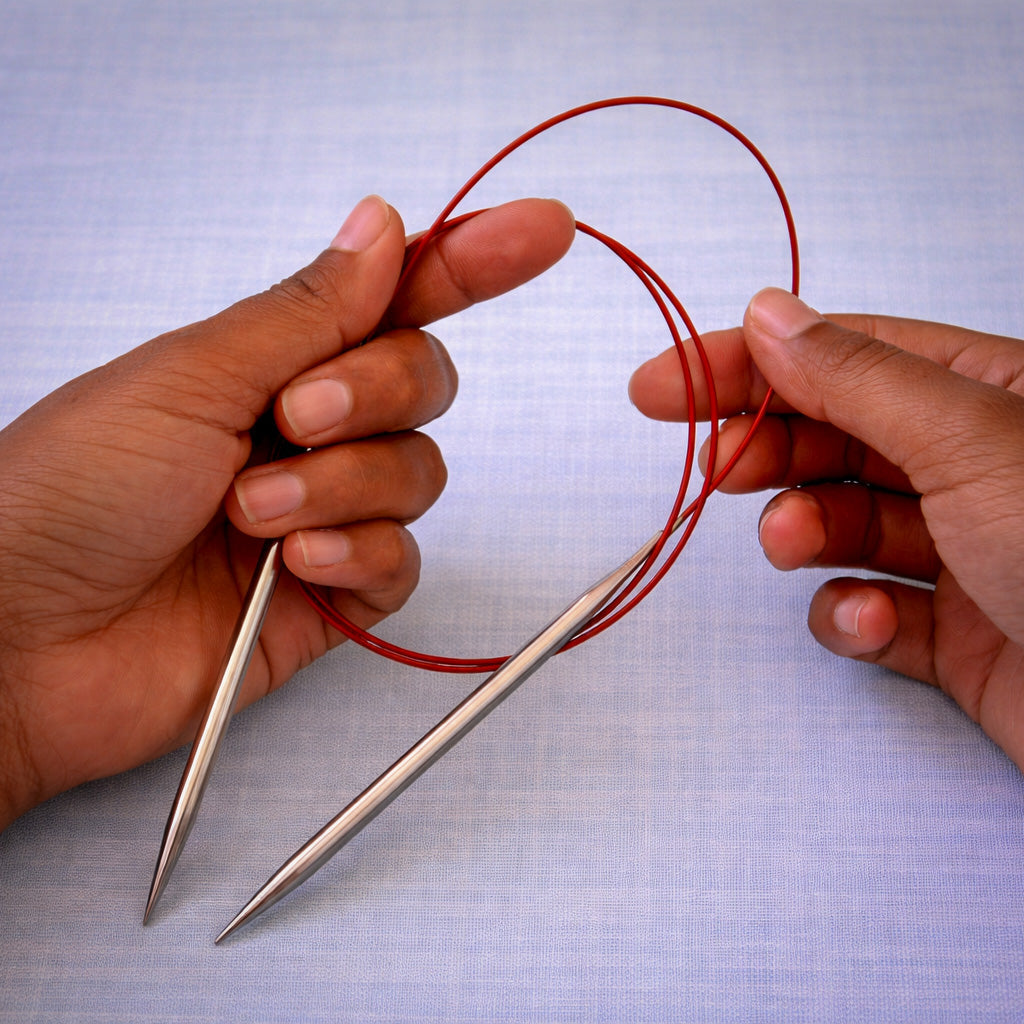
It happens to the best of us. You're deep into a project, yarn gliding perfectly, and then ... SNAP ... Your ChiaoGoo interchangeable cable breaks!
Before you panic or reach for your wallet, here's what to do right now, what the warranty covers, and how to make sure it never happens again.
Step One: File a Claim Directly With ChiaoGoo
If your cable snapped during normal use (no kinking, no forcing, no obvious misuse), then it almost certainly qualifies as a manufacturing defect. That's exactly what ChiaoGoo's lifetime warranty covers.
Here's all you need to do:
- Go to chiaogoo.com/replacement
- Fill out the short replacement request form
- Attach a clear photo of the broken cable
- Submit. ChiaoGoo replies by email with next steps.
Quick tip: ChiaoGoo's reply comes from customercare@chiaogoo.com, so check your spam folder if you don't see it.
From one of our reviews, "Had a product defect issue (which is rare and not seller’s fault) and the seller was quick to point me to where I can file a warranty claim. Quick shipping, too!"
What the ChiaoGoo Lifetime Warranty Covers
Every ChiaoGoo product purchased through an authorized dealer carries a lifetime warranty against manufacturing defects. Lifetime means the life of the product. ChiaoGoo covers manufacturing defects for as long as the product should last in normal use, and they list the full terms on their product warranty page. Because Smartisans is an authorized ChiaoGoo dealer, every purchase you make here is covered from day one.
The warranty covers manufacturing defects: problems that stem from how the product was made, not how it was used. A cable that snaps during normal knitting, a tip that separates at the join, or a connector that fails without an obvious cause are all prime examples.
The warranty does not cover normal wear and tear from years of use, accidents, misuse, or abuse.
The cable kinking exception: ChiaoGoo's red TWIST, blue X-Flex, and silver SWIV360 cables are memory-free. They lie flat right out of the package thanks to a multi-strand braided steel core inside the nylon coating. That same steel core is what makes them so flexible and strong, but it also means they will permanently hold a kink if they're pinched or compromised. Kinked cables are explicitly excluded from the warranty. A snapped cable is a different failure mode (structural breakage during use), and that is covered. But a cable that's been kinked and then fails is not. The good news: with proper handling and storage, kinking is entirely preventable.
Where you bought it matters, too. ChiaoGoo's lifetime warranty applies only to products bought through authorized retailers. Purchase from an unauthorized third-party seller, and you will have no warranty coverage at all, even if the product looks identical.
Smartisans has been an authorized ChiaoGoo dealer for more than a decade. That authorization means you buy with confidence, knowing any manufacturing defect will be handled years down the road, not just this season.
From another review, "I received the set in a timely fashion. well packaged and complete. Very happy with my purchase and the responsiveness of Smartisans. Hope I never need it but great to know I have a warranty through an authorized dealer vs large internet shopping site."
Why Do ChiaoGoo Cables Break? The Paperclip Principle
Understanding how these cables are built helps explain why they occasionally fail, and what you can do to prevent it.
ChiaoGoo's cables have a braided steel core. This is what makes them flexible, memory-free, and incredibly strong. But steel has one weakness: bend it back and forth sharply at the same spot enough times and it fatigues, the way a paperclip eventually snaps. ChiaoGoo says as much in its own warranty terms, which attribute cable failure over time to repeated bending, tight knitting tension, and lifting heavy projects by the cable or the joins.
This doesn't mean the cables are fragile. It means that small habits in how you hold your work and store your needles can make a meaningful difference in cable longevity.
7 Habits That Make Your ChiaoGoo Cables Last
1. Mind the Loop When Storing
When you coil your cables for storage, don't make the loop so tight that the join is bent. Keep the loop open enough that the cable stays in line with the needle at the join point. A sharp angle at the join, even in storage, adds up over time.
2. Make Sure Your Cable Is Long Enough for Your Grip
Cable length matters relative to how you hold your needles. If the cable is too short for your grip, it stretches taut between the tips, creating constant tension at the joins.
3. Keep Your Tips Up
Angle matters. When your tips are pointing upward, the cable flows naturally from the join. When your tips are horizontal and a heavy project is hanging down, the weight bears directly on the join, exactly where you don't want repeated stress. Think of keeping your tips up as your default knitting posture.
4. Notice Where the Join Sits in Your Hand
Pay attention to where the join lands in your hand. With 4-inch tips it can fall inside the palm; with 5-inch tips it usually sits farther back. If you can feel the join while you knit, or you catch yourself bending the cable sharply at your hand, try the other length. Our tip-length guide covers how to choose.
5. Special Care for Mini-Diameter Cables and Two-at-a-Time Socks
Mini-diameter cables require extra attention, particularly for two-at-a-time sock knitting. When possible, pull the needle into the stitches rather than pushing stitches along the cable; pushing creates uncontrolled bending at the join.
Scrunch both socks onto the front needle so the second sock isn't hanging down and pulling the join. When pulling out the back needle, give yourself enough room to form a smooth, open loop. Looping around and going under the cable before starting to knit creates a neat cross that keeps stitches close and prevents laddering, without stressing the cable.
If you're a tight knitter, be careful not to pull hard on the loop while the cable is crossed, as this can cause a kink at that point.
6. Respect the Weight of Your Project
As a project grows, its weight becomes a factor. The body of a heavy sweater hanging from your needles exerts real downward force on the joins. Keeping your tips angled upward distributes that weight through the cable rather than concentrating it at the join. It's a small adjustment with a noticeable impact.
7. Protect the Joins When You Put Your Knitting Down
It's tempting to set your knitting down mid-row, paying no attention to how it lands. Instead, take a few seconds to coil the cable so both tips point in the same direction and the joins aren't bent under the weight of the work. This is especially important for projects that will sit for a while.
The Bottom Line
A snapped ChiaoGoo cable isn't the end of the world, or the end of your set. File a warranty claim, attach a photo, and ChiaoGoo takes it from there. In the meantime, a few small adjustments to how you hold your work, loop your cables, and store your needles can mean you never need to file another one.
Submit a replacement request at chiaogoo.com/replacement
One more review that made our day, "Smartisans is an amazing small business with wonderful customer service. I even received a personal email regarding ChiaoGoo's lifetime warranty and how Smartisans would help if I ever needed it. Love this company!"
Updated August 30, 2026