
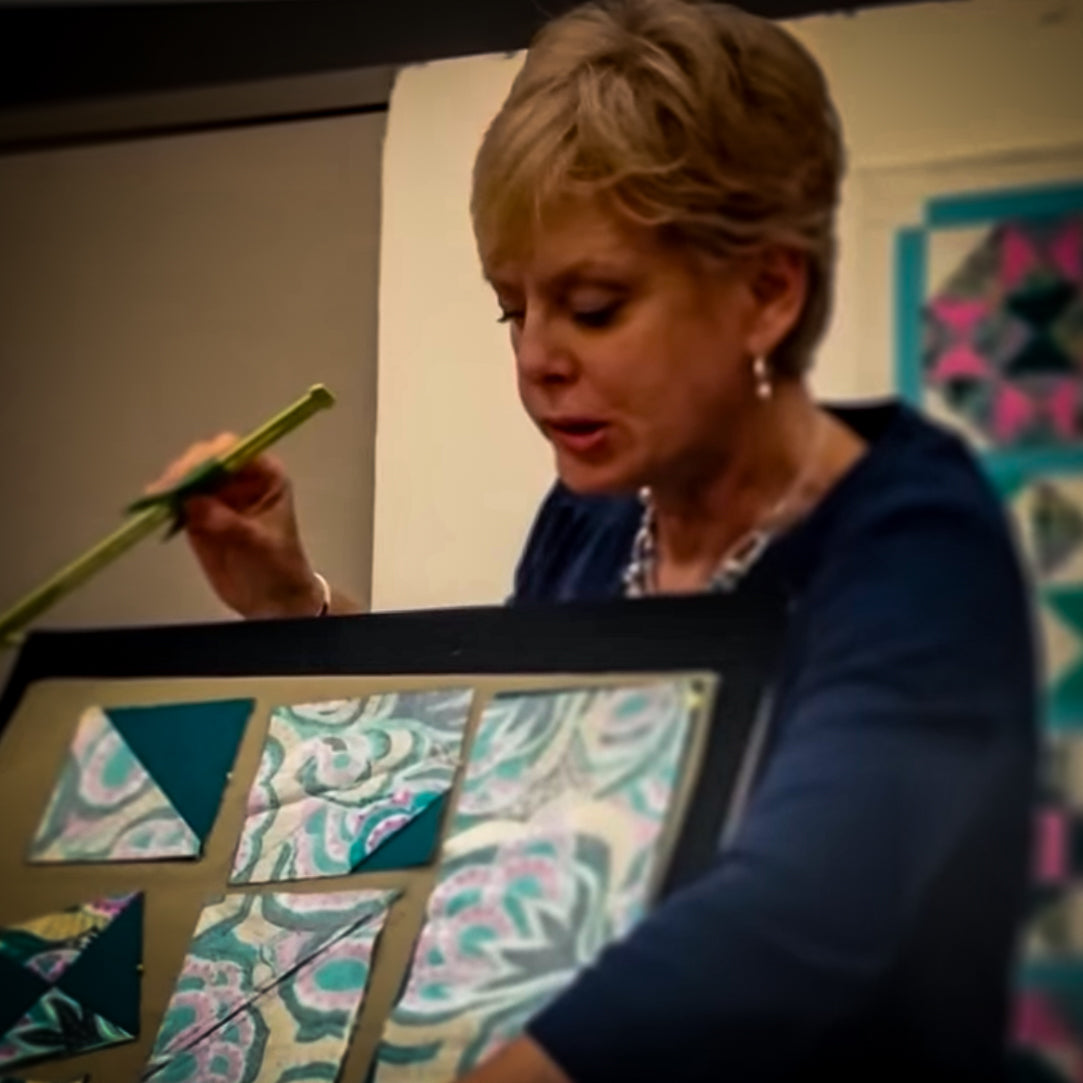
Nancy Zieman taught sewing on television for 35 years. Sewing With Nancy began in 1982 and ran to more than 900 episodes, and along the way she built Nancy's Notions, a mail-order notions business she started at her kitchen table. She died on November 14, 2017, at 64.
Here is how she taught, the landscape quilting method she learned from her friend Natalie Sewell, her final program about sewing with children, and the charity sewing she featured on her show, with the supplies we carry for each.
From a 4-H Demonstration to Public Television
Nancy grew up on a dairy farm in Wisconsin. Her first 4-H demonstration showed how to sew on a waistband, and when she finished it she knew she could teach. She went on to study clothing and textiles and journalism at the University of Wisconsin-Stout.
While she traveled teaching sewing seminars, people kept asking where to buy the notions she demonstrated. She answered with one printed sheet listing ten notions, and Nancy's Notions grew from that sheet into a company with 120 employees.
She taped the first 11 episodes of Sewing With Nancy in her own house in 1982. When the original producer dropped the show in 1983, she took over production at her own expense, airtime included, and chose Saturday mornings so working women could watch. By the early 1990s Wisconsin Public Television produced the show, and public television stations across the country carried it.
Bell's palsy, which struck when she was a toddler, left part of her face paralyzed, and she doubted she had a face for television. In one episode she brought a neurologist on the show to answer viewers' questions about it directly.
How She Taught
Sewing With Nancy was a project show. Nancy showed the finished piece first, then worked through it step by step, with no flashy graphics or effects between the viewer and the sewing.
She sat at the machine angled toward the camera so viewers saw the work as they would see it at their own machine, even though the position made her own stitching harder. Her advice ran to specifics, such as choosing thread one shade darker than the fabric, and to encouragement: "You just need to practice."
Landscape Quilts With Natalie Sewell
Sewing and gardening were two of Nancy's favorite hobbies, and landscape quilting combined them. Natalie Sewell, a landscape quilt artist, taught her the technique, and the two wrote books together, including The Art of Landscape Quilting (2007, reissued in 2025).
Their method starts from a photograph instead of a pattern. The photo sets the scene, and the fabric choices take over from there. A first quilt can use as few as four fabrics, background included. Batiks and hand-dyed fabrics make good backgrounds because their dappled color does much of the work of showing light.
Natalie cuts with scissors, never a rotary cutter, because straight cuts make trees look like telephone poles. She cuts tree trunks loosely, wider at the base and irregular on purpose, a technique the two call messy cutting. They fussy cut leaves from print fabric, sometimes from fabric never meant to be leaves. On one quilt, Natalie cut leaves from a print of bananas for its shading.
For small leaves and the thin slivers that shade a trunk, Karen Kay Buckley's Multi-Purpose Perfect Scissors have stainless steel blades about 1 3/4 inches long that cut sharp to the point. Karen Kay Buckley designed them for fabric, templates, and fabric backed with fusible, and the soft grips work in either hand.


Nancy and Natalie baste each piece in place with an ordinary paper glue stick. It dries clear and does not gum up the needle. With the pieces glued down, they shade each trunk with a black permanent marker on the side away from the light and draw in fine branches with black and silver permanent pens. Stitching and stippling hold everything permanently at the end.
Their method uses no fusible web. If you would rather bond each piece before you stitch, Mistyfuse does it without adding bulk. It is sheer, has no paper backing and no added adhesive, and bonds firmly once it cools. It works on cottons and also on sheers such as tulle and organza.


A nonstick pressing sheet keeps fusible web off the iron. The Goddess Pressing Sheet is Teflon-coated fiberglass, and its Goddess Curve marks one side for the iron and the other for the fusible. The gloss it leaves on fused fabric shows which side carries the Mistyfuse.

PBS Wisconsin has posted Nancy and Natalie's Landscape Quilting Workshop on YouTube. In Part 1 they cut, shade, paint, and stipple trees, with light and dark trunks and trees both near and far.
I Sew for Fun: Her Last Program
Nancy's cancer returned in 2017. Her last Sewing With Nancy program was I Sew for Fun, about adults and children sewing together, and she recorded it with her granddaughters. When she could no longer come to the studio, the crew brought the cameras to her house so she could finish one episode. It closed with her usual sign-off, "Bye for now."
The companion book, I Sew for Fun, has 20 projects, among them aprons in three sizes, a pillowcase, and a drawstring backpack. It sets aside many of the usual sewing rules and leaves the fun parts to the child.
Mary Mulari, one of Nancy's regular guests on Sewing With Nancy, designs apron patterns we carry. Her Little Sister and Brother Apron pattern makes two reversible styles for children: a crisscross apron in size medium, with bands that cross in back and button on the front, and a classic full apron in small and medium. You can make the small size from two fat quarters.


Her Crisscross Apron for adults is reversible, cut from two 1-yard lengths of fabric, with two pockets on each side and no ties. Both patterns include a crisscross style, so a child's apron and an adult's can match.


Mary was Nancy's guest for a two-part series, Easy Reversible Aprons: Everyday and Elegant. In Part 1 the two show four of Mary's reversible apron styles, including a child's apron.
Sewing to Give
Many episodes ended with Nancy's Corner, a segment that often featured volunteers sewing for others: caps for people who had lost their hair to chemotherapy, quilts for people without homes. After a segment aired, donated items arrived by the thousands. In December 2015 she gave this work a name, Sew To Give, and her Quilt to Give events gathered sewists at Quilt Expo in Madison to make quilts for donation.
Where to Watch Her Now
PBS Wisconsin made a 90-minute documentary about her life, Nancy Zieman: Extraordinary Grace, in 2020. It streams for PBS Wisconsin Passport members, and a short preview is free. Episodes of Sewing With Nancy, including the landscape quilting series and I Sew for Fun, are on the PBS Wisconsin site, and PBS Wisconsin has posted more than 150 full episodes in a Sewing With Nancy playlist on YouTube.
The Bottom Line
To try Nancy and Natalie's landscape method, start with a photo you took, four fabrics including the background, small sharp scissors, a paper glue stick, and a black permanent marker. To sew with a child the way I Sew for Fun describes, choose a small project such as a child's apron from two fat quarters, and let the child pick the fabric. To sew for others, ask a local guild or church whether it runs a charity sewing group.